
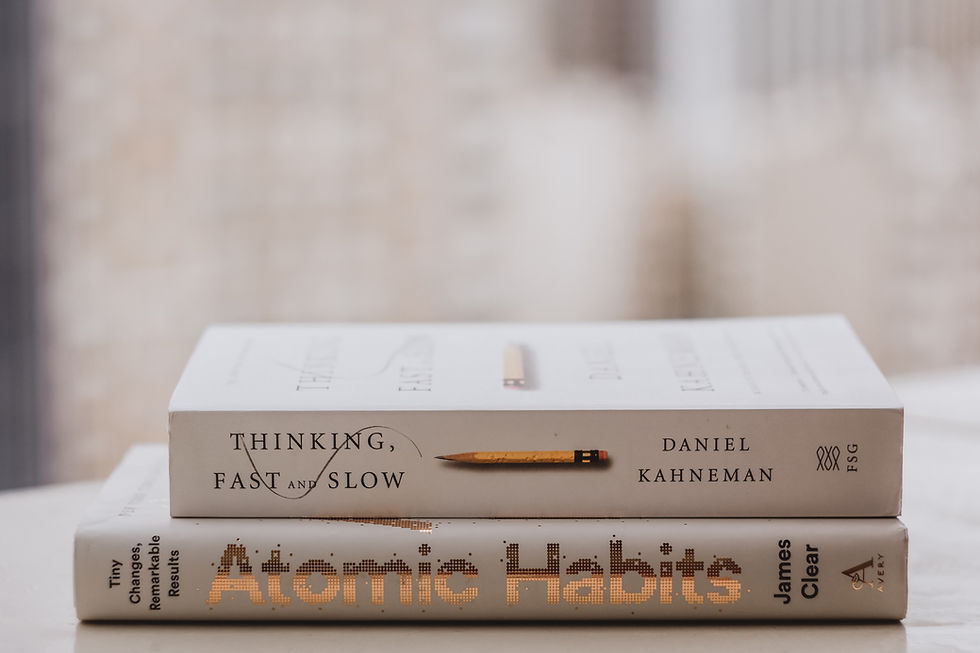
Top of the Reads Book Recommendations: Atomic Habits by James Clear
- Heather Thompson

- Aug 11, 2021
- 4 min read
Updated: Apr 15
I just finished reading this book for a second time, and cannot recommend it highly enough if you're looking to make changes that stick.
So what is a habit?
"A habit is a routine or behavior that is performed regularly - and in many cases, automatically"
When we look to make changes, we often start by arming ourselves with the knowledge we need. We read a book. Start a course. Start to follow an expert on social media. What I've learnt though is that knowledge by itself is not enough. It requires action. In fact too much knowledge can keep you as stuck as knowing nothing at all. It's a form of procrastination in itself. When we go after knowledge, we also need to go after aligned action. Small changes that will build up to create momentum are powerful for long lasting change. That is where creating positive habits, and losing bad habits, comes in.
Why do we even care about habits? Good habits will help you achieve your full potential. Nothing is worse than a life half lived, living in the shadow that you could have done or been something more. Habits help you kickstart your life in that desired direction. For example, getting in the habit of drinking more water, helps you in the direction of leading a healthier life.
If you're looking for a review of the book I'd recommend to check out the review on Good Reads. Here, I wanted to talk about the learnings that really resonated with me from this book, what I actually took away and implemented.
My top 5 takeaways
What you do consistently is more important than what you do every now and again
Use habit stacking to kickstart a new habit
Understand the feelings behind your habits
Process and systems beat out motivation and discipline
Get specific
1. What you do consistently is more important than what you do every now and again
The main message of the book is that small habits can compound into big changes i.e. tiny changes, remarkable results.
"Changes that seem small and unimportant at first will compound into remarkable results if you're willing to stick with them for years"
We often dismiss small habits because they don't seem to make a big enough difference in the moment. They don't feel dramatic enough. For example, have you ever set yourself a goal to get fitter, and instead of doing something simple like increasing your daily steps, you went straight for something dramatic like signing up for a marathon or a bootcamp? That's the "Go big or go home" manta, and while that may works for an "all or nothing" personality type (for a time I would argue), its problematic. Many of can't sustain that level of intensity coming from a low fitness level, and so get disheartened and stop. Instead, look to get 1% better everyday.
The best route to success is to look for small changes that will compound over time. I think it's because it helps you build confidence and momentum, two really powerful forces for change. In Clear's words, a "slight change in your daily habits can guide your life to a very different destination".
2. Use habit stacking to kickstart a new habit
Habit stacking is about pairing an existing habit with a new habit. You tie the new habit you want to cultivate into something you already do each day.
"After [CURRENT HABIT], I will [NEW HABIT]"
For example, "On my commute (current habit), I will listen to audiobooks (new habit) ".
Again this is really talking about starting simple (by focusing on something we already do), and creating momentum for ourselves. The existing habit acts as a cue for the new habit we wish to cultivate.
3. Understand the feelings behind your habits
In the famous words of Simon Sinek, start with why. Why do you want to take up this new habit? One thing to understand is what feeling you are chasing by engaging in this habit. Clear talks about "What you crave is not the habit itself, but the change in state it delivers". Clear gives the example that it's not so much smoking the cigarette that you crave, it's the feeling of relief it gives. If you want to take up a new exercise routine, is it the exercise you crave or the feeling of feeling fit or confident or disciplined? Understanding the end result of how you want this new habit to make you feel, moves it past just a to do list item, to something linked to our sense of purpose.
4. Process and systems over motivation and discipline
"Your habits are shaped by the systems in your life"
Clear recommends to design your environment, the invisible hand that shapes human behaviour, around the 4 building blocks of creating good habits which are:
Make it obvious
Make it attractive
Make it easy
Make it satisfying
I think what Clear is urging here is to set yourself up for success. For example if you want to cook more but don't do a weekly food shop, then you're more likely to need to rely on motivation and discipline at the end of a busy day to not order takeout, than if you had specific ingredients for a specific dish you had pre planned to make. In essence, try remove as many roadblocks as possible from you sticking with your desired new habit. Interestingly Clear notes a phenomenon that I've definitely experienced first hand i.e. habits can be easier to change in a new environment. This is why moving homes, job, gyms etc can be such excellent times to reset on any bad habits we've fallen into.
5. Book recommendations: Be specific
It really helps to take any ambiguity around what you need to do, or when. If we give ourselves too much choice when starting a new habit, it can be overwhelming to get started. And without action we have no momentum, and so no hope of success. Instead of saying something generic like "I want to start meditating daily", be specific. "I am going to mediate for 3 minutes every morning after I journal using the Insight Timer App". This specificity makes it easier to start your new habit.
If you're interested in creating some new habits, then I would definitely recommend to read this book as there are plenty more nuggets of wisdom in there. If you have already read it, would love to know what really resonated with you?


Comments